
Carroll County Criminal Court Cases
Carroll County uses Virginia's tiered trial-court structure. Carroll General District Court adjudicates most misdemeanors and conducts preliminary hearings in felony matters. That preliminary hearing tests whether probable cause supports sending the charge onward. It is not a felony trial. After certification or indictment, Carroll Circuit Court, part of the 27th Judicial Circuit, keeps the felony prosecution file. Juvenile and Domestic Relations District Court handles juvenile matters and the adult criminal jurisdiction assigned to that court, with greater limits on public access.
The Circuit Court clerk is the custodian of Circuit Court pleadings, docket entries, judgments, and certified copies. General District Court maintains its own record. A person who searches only one Carroll County court can miss the first or later part of a felony. Hillsville has no separate municipal criminal court, so town charges use the applicable Carroll court path rather than a town-run case portal.
The official Carroll Circuit Court page shows the court's published contact and local information.
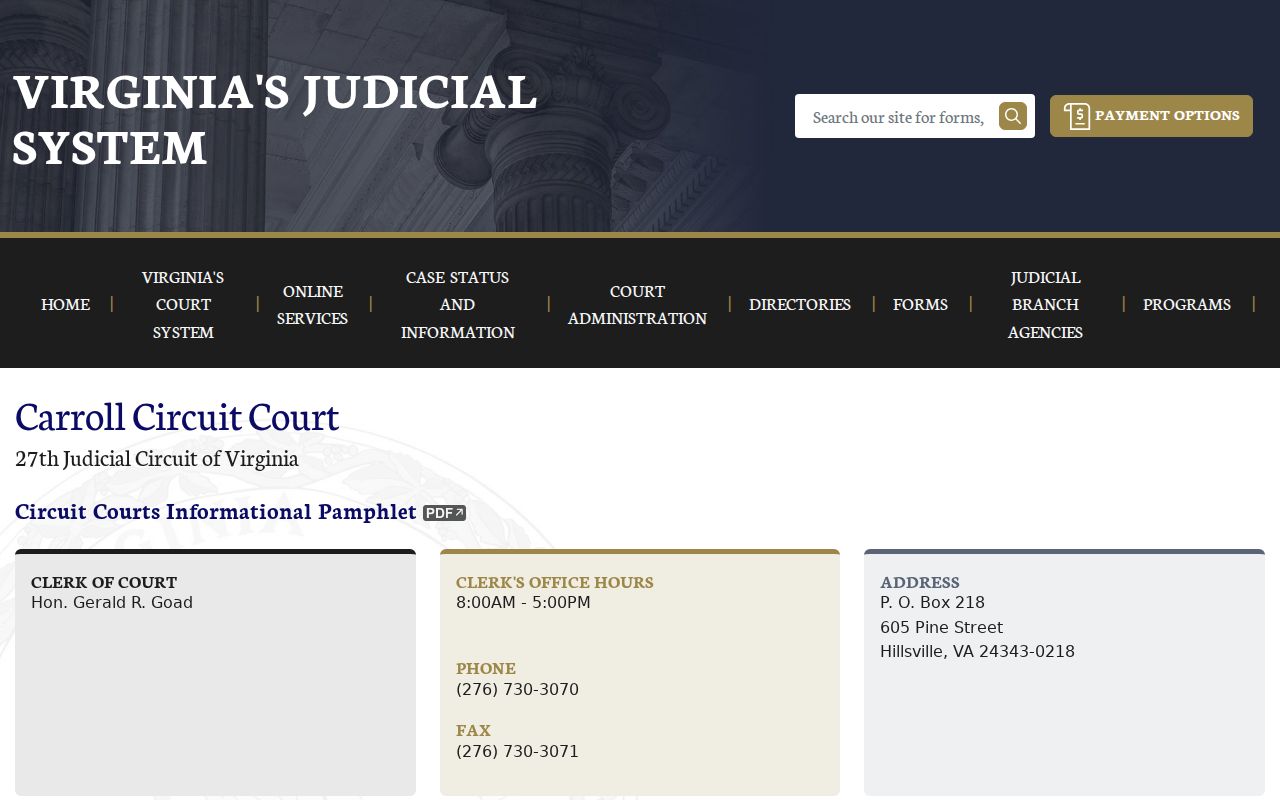
That official listing is the place to confirm clerk details before seeking a Carroll County criminal case file.
Virginia OCIS for Carroll Cases
The Virginia Judiciary Online Case Information System 2.0, or OCIS, is the statewide entry point for public case searches. Its terms and coverage controls apply. Select Carroll Circuit Court or Carroll General District Court and use the most exact identifier available. An exact case number is stronger than a common name. Court, charge, filing date, status, and hearing details help distinguish similar results without sharing private identifiers.
The official OCIS landing screen makes the terms-acceptance step clear before a Carroll County case search begins.
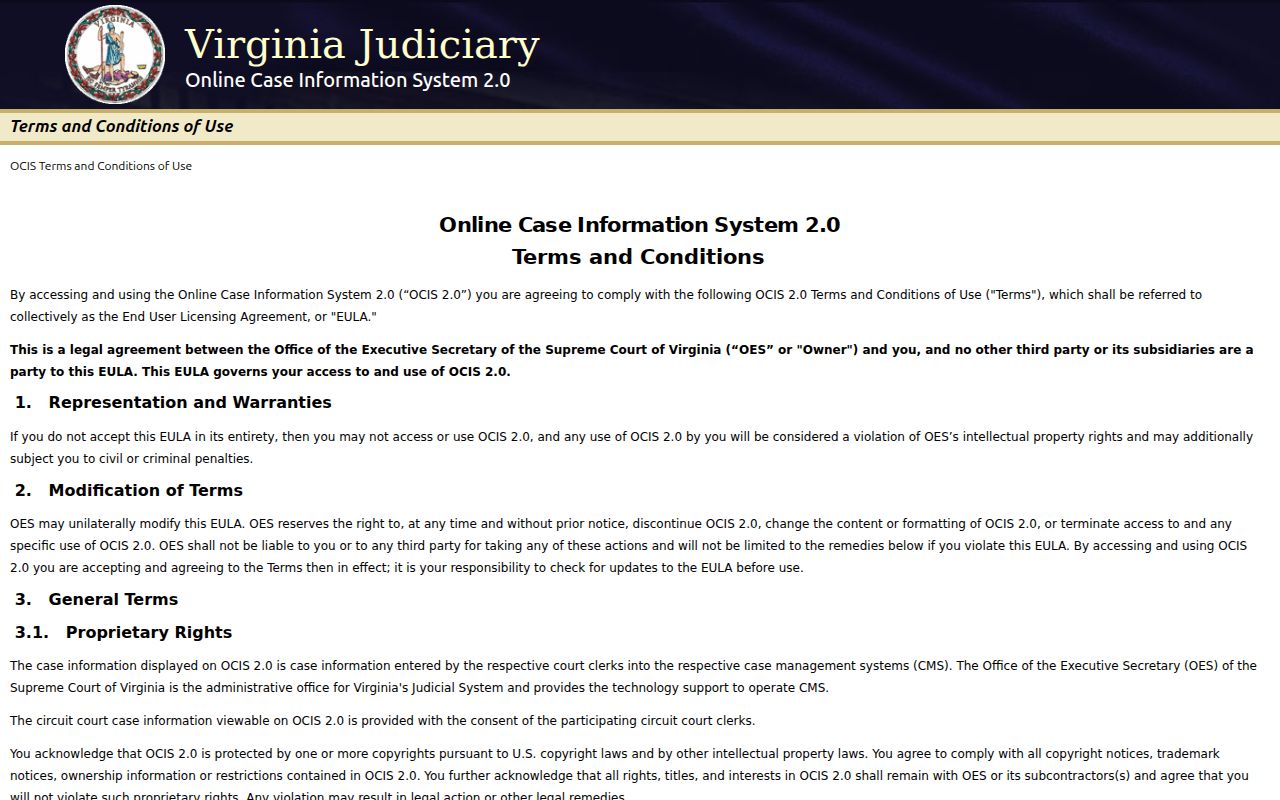
Once inside, choose the correct locality and court level because a statewide name query is not a substitute for checking both Carroll trial courts.
The Judiciary also maintains a case-information directory that separates its Circuit Court and General District Court search choices.
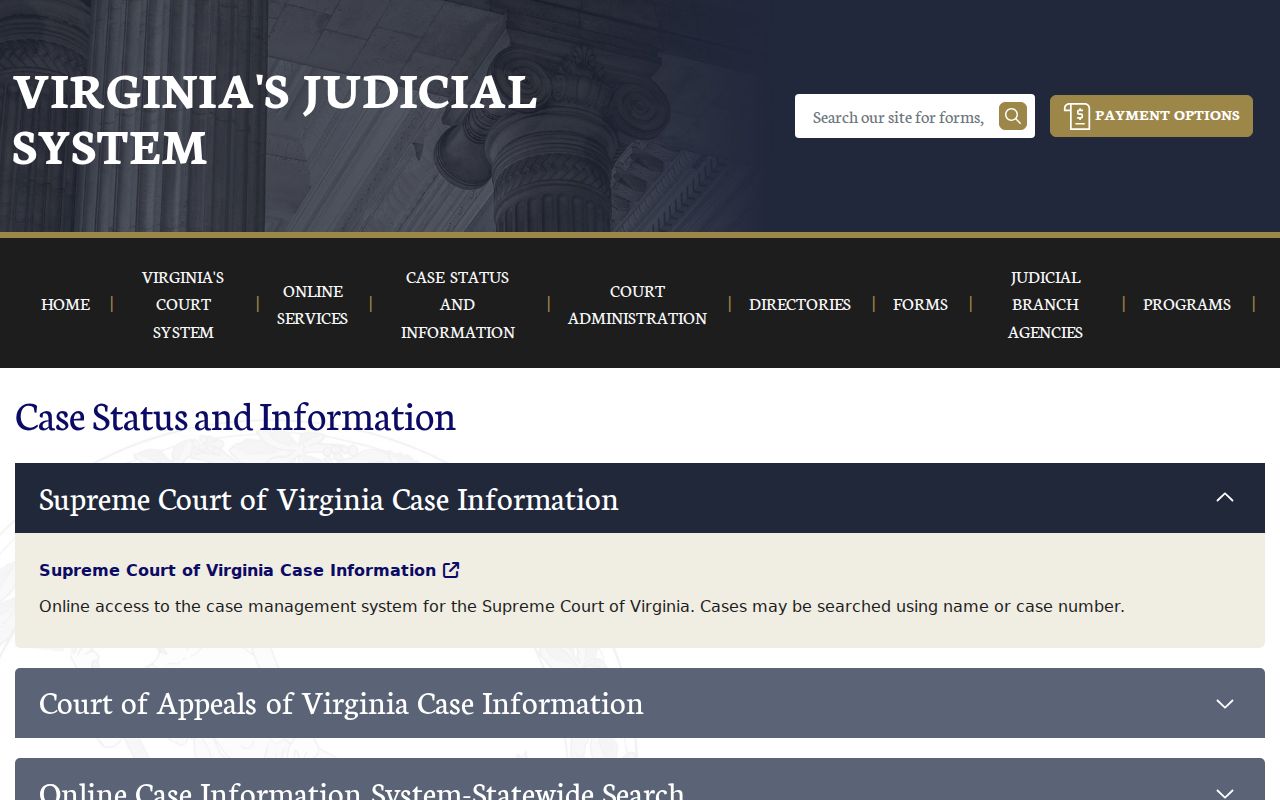
The separate choices explain why a person may need two searches to trace one Carroll County felony from its preliminary stage to Circuit Court.
Searching Carroll County Case Records
Begin online, then use the clerk as the fallback and certification channel. Portal data is useful for locating a case and reading public event entries, but it is informational. Documents may not be downloadable, old material may remain offline, and a hearing time can change. The following sequence keeps the Carroll County search tied to the official file.
- Open OCIS or the Virginia Judiciary case-information directory and accept the posted terms.
- Select Carroll Circuit Court and Carroll General District Court as the facts require. For a felony trail, check both.
- Search by exact case number when known. Otherwise use the official name spelling and narrow by date, charge, or case type.
- Compare the court, number, status, charge, hearing date, and disposition. Do not treat the charge itself as an outcome.
- Contact the appropriate clerk for a public document, certified disposition, missing entry, or archived Carroll County court record.
The visible controls can change after the user accepts the court system's terms. These captured fields describe the official search choices documented for the project.
| Field Label | Type | Required | Notes |
|---|---|---|---|
| Court/Locality | Selector | Yes | Choose Carroll Circuit or Carroll General District. |
| Name | Text | Search-dependent | Use the official spelling and try documented variants. |
| Case Number | Text | Alternative | An exact court number is the strongest key. |
| Hearing Date/Range | Date | No | Narrows calendars or dockets where offered. |
| Case Type | Selector | No | Available choices depend on the court interface. |
| Search/Clear | Buttons | Not applicable | Runs the query or removes the entered criteria. |
Note: A blank search does not prove that no Carroll County case exists, especially when a file is old, sealed, protected, or misidentified.
Why Carroll Felonies Gain Numbers
One alleged event can create distinct Carroll County case numbers because each court opens and controls its own file. A felony complaint commonly appears first in General District Court. There, the docket may show arraignment, bond events, continuances, and a preliminary hearing. If the charge is certified, or if a grand jury returns an indictment, Circuit Court opens a separate prosecution. The later Circuit number does not erase the General District number.
Searchers often mistake the first court's final event for the final result of the whole prosecution. A certification means the felony moved forward. It is not a conviction. Likewise, an amended charge can cause the text seen at arrest, at preliminary hearing, and at final judgment to differ. Match dates, allegations, and court events before deciding that two Carroll County entries are unrelated.
Note: Read the event label and court level together; the word “final” may describe that court's stage, not the full felony case.
Inside a Carroll County Case File
A Carroll County court file organizes one prosecution, not every event in a person's Virginia history. Its docket can identify the court, case number, charge, counsel, scheduled events, outcome, and sentence. It may also index motions or pleadings that are available only from the clerk. The court summary should remain separate from a sheriff incident report, a jail booking file, and a VSP CCRE criminal-history response.
| Case Number and Court | The court-specific identifier and whether General District, Circuit, or J&DR controls the file. |
|---|---|
| Charge | The alleged offense, statute, class, and any original or amended description shown publicly. |
| Docket Entries | A dated index of hearings, continuances, motions, pleas, findings, and other public events. |
| Hearing Details | The date, time, court, and hearing type, subject to clerk confirmation. |
| Disposition | The result for each charge, such as guilty, dismissed, nolle prosequi, acquitted, or deferred. |
| Sentence and Financial Entries | Public jail or penitentiary terms, suspended time, probation, fines, costs, and payment status where exposed. |
| Documents and Redactions | Public document metadata may appear, while protected identifiers, victim data, juvenile material, and sealed content do not. |
A certified disposition is often the clearest clerk-authenticated statement of what happened to a charge. A portal screen may be enough for orientation, but it does not carry the clerk's certification.
Certified Carroll County Court Dispositions
Carroll Circuit Court's criminal counter is in the second-floor left wing of the Carroll County Governmental Center, 605 Pine Street, Hillsville, VA 24343. The clerk's published hours are 8:00 a.m. to 5:00 p.m., and the main line is 276-730-3070. Staff also accept document-order inquiries by phone or staff email. Provide the case number or other identifying case data so the clerk can locate the correct public record.
The posted Circuit Court copy price is $0.50 per page. Card payment and an emailed receipt are available through the documented request process. Ask whether a plain copy or a certified copy fits the need, since certification adds the clerk's official authentication. General District Court keeps its own files and publishes separate hours, 8:00 a.m. to 4:00 p.m., and phone number, 276-730-3050. Calling first is wise when a record may be archived or the desired item is not visible online.
Carroll Circuit Court Clerk
605 Pine Street
Hillsville, VA 24343
276-730-3070
Monday through Friday, 8:00 a.m. to 5:00 p.m.
Carroll General District Court
Carroll County Governmental Center
Hillsville, VA 24343
276-730-3050
Monday through Friday, 8:00 a.m. to 4:00 p.m.
How a Criminal Case Moves
A filed charge begins a court record, but the path depends on the offense and later rulings. General District Court can resolve most misdemeanors. A felony generally uses that court for its early stage before certification or indictment leads to Carroll Circuit Court. Pleas, motions, amendments, and continuances appear as separate docket events, while the disposition states the result for a charge. Sentencing may occur with the disposition or later.
Case flow: Charges Filed › Arraignment › Pretrial › Plea or Trial › Disposition › Sentencing
That flow is a reading aid, not a promise that every Carroll County case has each public step. A misdemeanor may remain in General District Court. A charge may be dismissed before trial. Circuit criminal court is usually held Tuesday at 9:00 a.m., while terms and grand-jury timing follow the local schedule. Always confirm a live hearing with the clerk.
Reading Carroll County Case Outcomes
Disposition words answer different questions. “Guilty” records a judgment following a plea or adjudication. “Dismissed” ends that charge without a guilty judgment. “Nolle prosequi” means the prosecutor chose not to proceed at that time, and an acquittal is a not-guilty determination. A deferred disposition delays adjudication under legal conditions and should not be called a dismissal until the required process is complete. Reading each count matters because one Carroll County case can have different outcomes for different charges.
- Disposition
- The recorded outcome of a specific charge.
- Nolle prosequi
- A prosecutor's decision not to continue that charge at that time; it is not a conviction.
- Indictment
- A grand-jury accusation that allows a felony prosecution to proceed in Circuit Court.
- Capias
- Court process directing that a person be taken into custody.
- Certified copy
- A copy authenticated by the clerk as an official court record.
Virginia's felony punishment statute sets class-based ranges, but the charge statute and judgment control an individual Carroll County case.
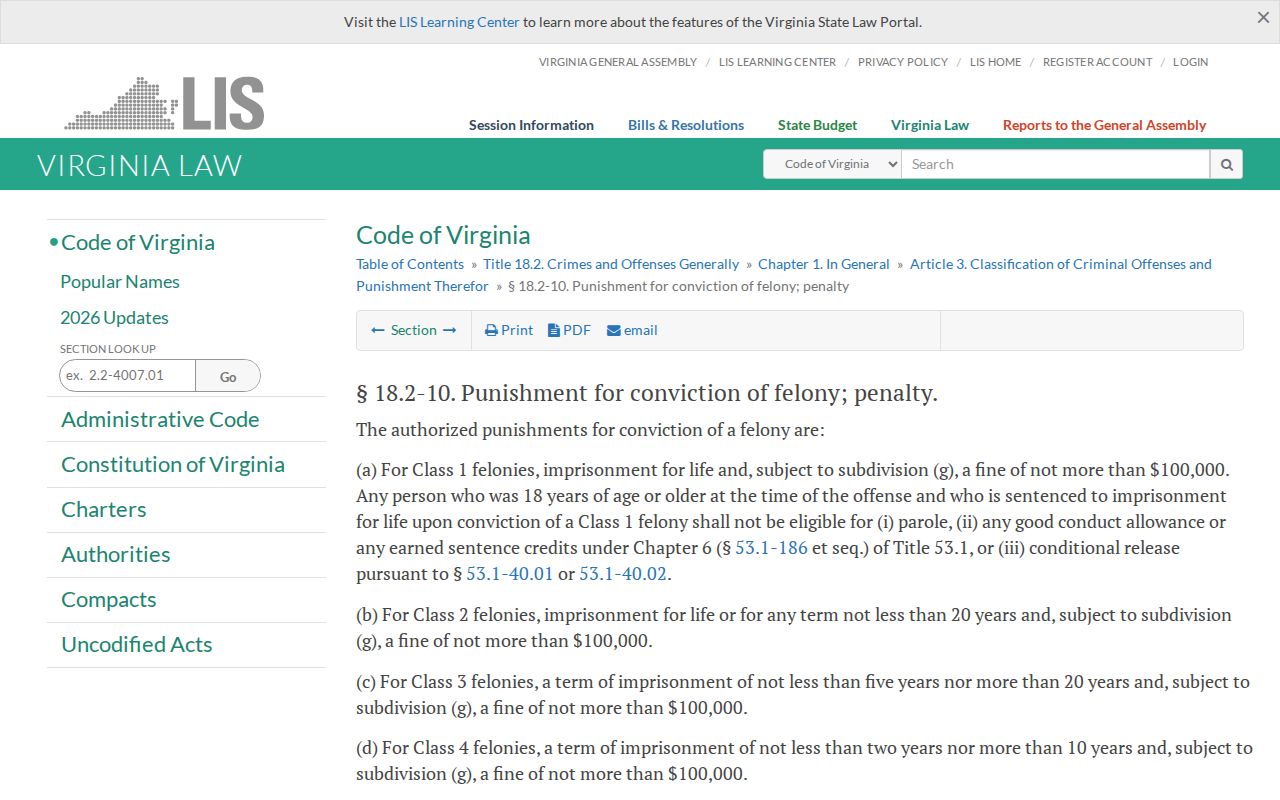
The statute helps decode a felony class shown in a Circuit Court record without replacing the sentence entered in that case.
Virginia's separate misdemeanor punishment statute supplies the ranges for the four misdemeanor classes.
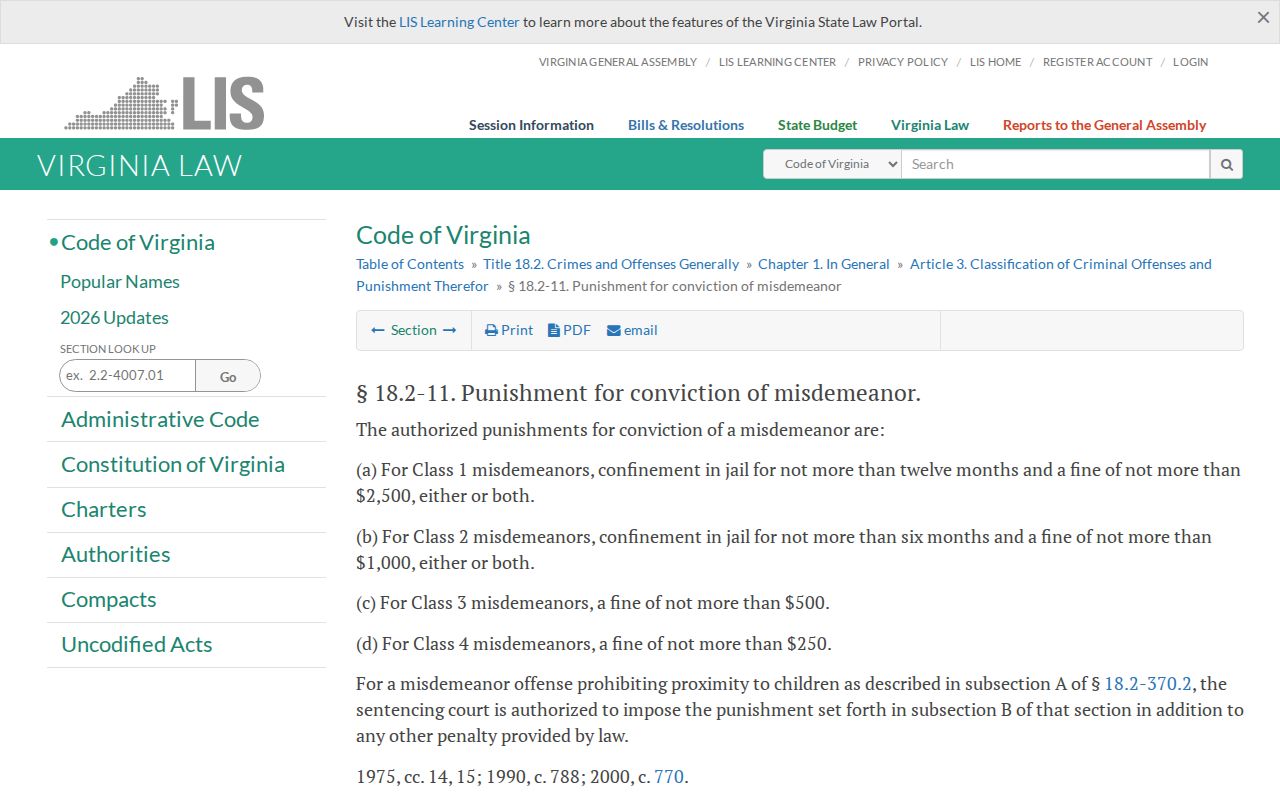
A General District Court docket may also show an unclassified offense, so the cited offense law remains more precise than class alone.
Case Record Access & Restrictions
Public Carroll County court files are accessed through court rules and clerk-record law, not the ordinary agency-record path under VFOIA. Virginia Code § 17.1-208 governs inspection and copies of records kept by Circuit Court clerks and permits clerk fees. The online docket offers public case information, while the clerk controls the official court file and certified copy.
Access has limits. Sealed matters, juvenile files, protected victim or minor information, full Social Security numbers, financial account data, and other restricted material should not appear in a public result. A missing online entry may also reflect an older paper or microfilm record, delayed data, a spelling difference, or a case filed in the other Carroll County court. Ask the clerk which explanation applies rather than assuming that the record never existed.
Clerk rule: Request court pleadings and certified dispositions from the court clerk. VFOIA routes agency records, but it does not replace the judiciary's access rules for court files.
Archived Carroll County Case Records
An empty OCIS result does not end the search for an old Carroll County case. The Circuit Court clerk can check archived, off-site, paper, microfilm, or digitized holdings that the public interface does not display. Give the clerk as much case data as is safely available, such as the court, approximate year, party name, case number, or charge. Ask whether the file can be retrieved, whether conservation limits handling, and what copy or certification options apply.
The Library of Virginia documented Carroll's renovated records archive in August 2024. The secure space is climate controlled. Volunteers organized loose records in flat files and archival-quality containers, and many items were digitized, though some conservation work remains. That project makes the clerk counter especially important for historical and genealogical research. It also shows why “not online” and “not held” are different answers.
For a current prosecution, confirm the live docket and hearing details with the relevant clerk. For an arrest report, contact the agency that created it. For the broader path from arrest into prosecution, the county's arrest lookup information explains the separate custodians without merging their records.